Spring family pictures outfits range from effortless cream-and-tan neutrals to carefully plotted gingham and florals, and the right choice depends on one thing: whether your session runs warm or swings sixty degrees before the photographer arrives. A mid-weight cotton around five to six ounces per yard holds its drape through both weather and grass stains, while polyester throws back a shine that reads cheap against new spring light.
1. Light Neutrals
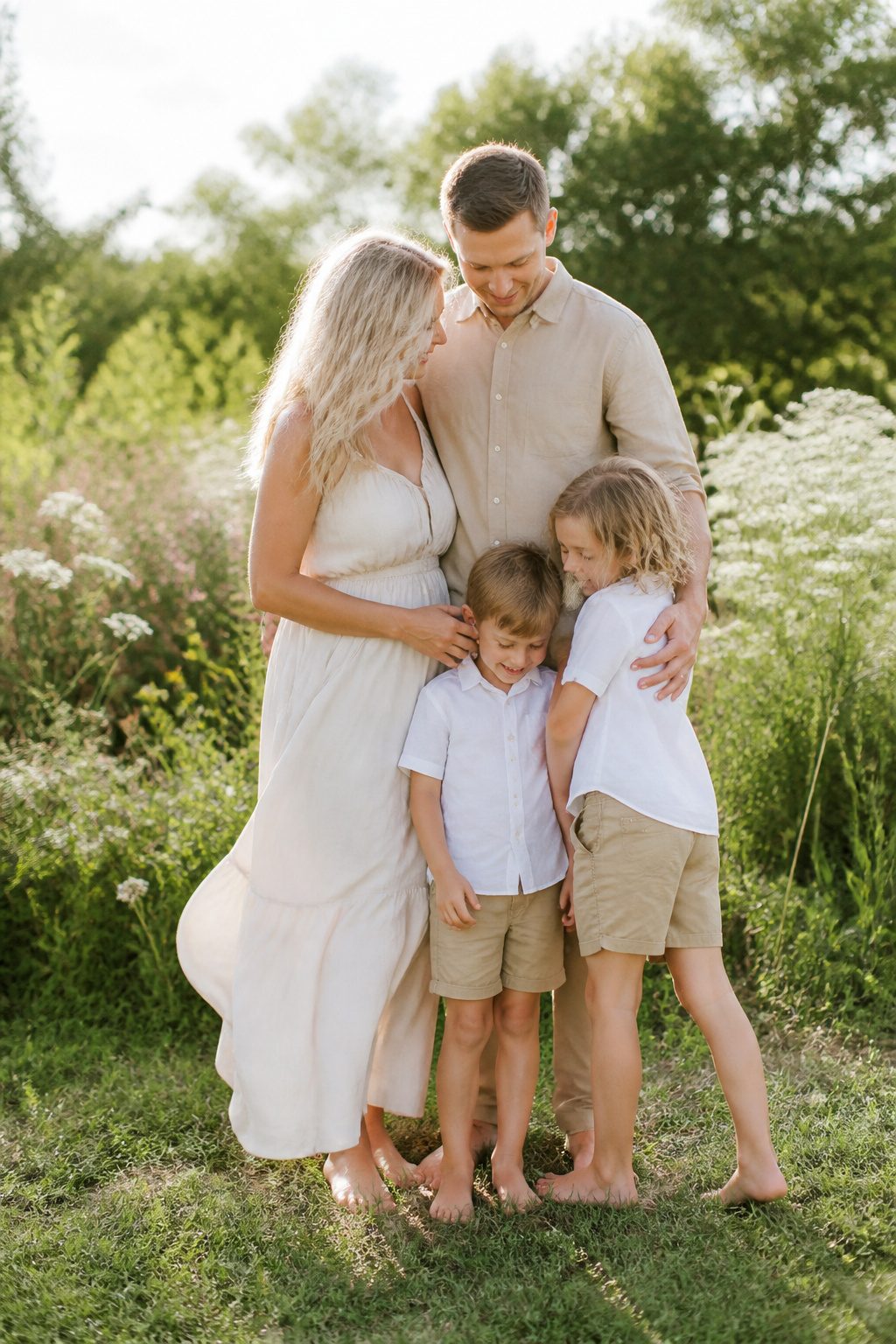
Cream, tan, and soft white form the base palette that almost every photographer recommends first for spring family pictures outfits. These light neutrals work because spring backdrops are already doing the heavy lifting: tall grasses, wildflowers, and the year’s brightest greens. A neutral base lets that scenery shine instead of fighting it for attention.
The real payoff comes in coordination. When most of the family wears muted tones, you avoid the visual clutter that happens when too many bold patterns or saturated colors stack up in one frame. One or two family members can layer in a complementary color (sage green, dusty blue, or soft blush work here) without the group looking mismatched. Patterns stay limited to one or two people, and they coordinate rather than compete.
Neutrals also buy you flexibility across settings. The same cream or tan base looks right in a garden, a field, or an indoor studio, and the palette holds up if your session runs into early summer. If you are unsure where to start, start here.
2. Soft Pastels
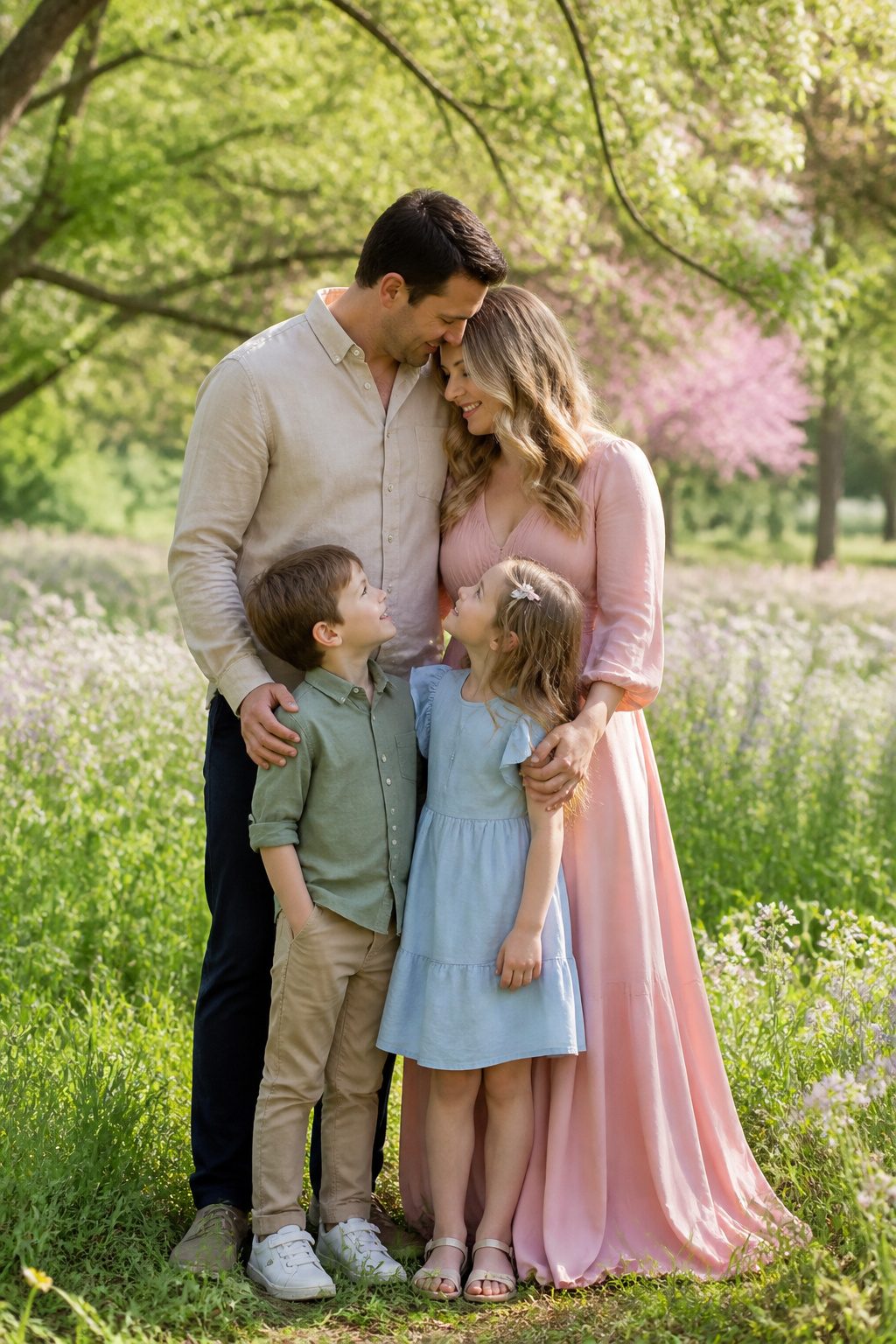
Soft pastels are the second most-backed palette after neutrals for spring family pictures, and for good reason. Blush, sage green, and baby blue layer cleanly with cream, beige, or soft white without fighting the season’s natural backdrop of blooming trees and tall grasses.
The mistake is dressing everyone in the same shade. Instead, vary tones within the same family so outfits coordinate without matching exactly. If you wear a blush dress, your partner can carry that same color as a subtle accent, a pocket square or a thin stripe on a neutral shirt, while the kids split sage green and baby blue between them. One patterned piece, like a soft floral blouse, works if the rest of the group stays solid.
Spring weather shifts fast, so a light cardigan or linen layer in a complementary pastel keeps the palette intact if temperatures drop mid-shoot. Stick to light cotton, linen, or flowy fabrics that catch the breeze rather than stiff structures that look forced against soft scenery.
3. Earthy Tones
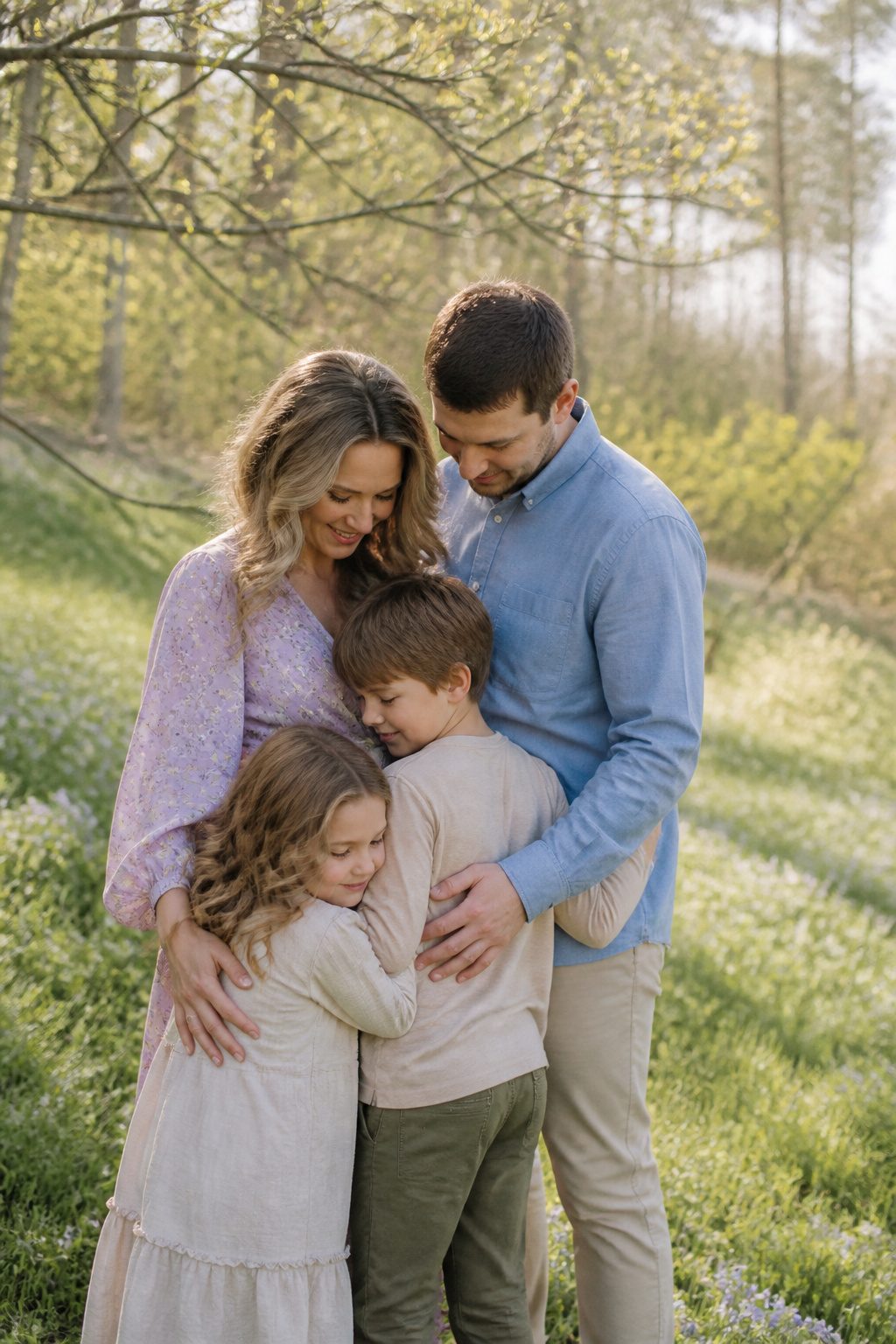
Dusty blue and muted lavender sit in the useful middle ground between true neutrals and spring pastels. They carry enough color to keep a family grouping from going flat, but they do not fight the setting the way saturated tones can. In outdoor spring photography, these shades pick up the ambient light and reflect it back softly, which matters when you are working with early-season sun that still has some winter harshness to it. The cooler cast of dusty blue reads particularly well against new green grass or blossoming branches; muted lavender does similar work in meadow settings where wildflowers are already showing purple notes.
The distinction worth keeping is saturation. Olive green or rust in a bright, clean mix will read autumnal against spring growth, which is the wrong season entirely. The same colors in a washed, dusty form stay current to April and May. Dusty blue flatters cooler and neutral skin tones without pulling pink the way a brighter sky blue can; muted lavender tends to warm olive and deeper complexions rather than washing them out. If you are building a palette around either one, pair it with cream or soft white rather than stark optical white, and add one other muted tone at most so the group does not fragment visually.
4. Denim and White
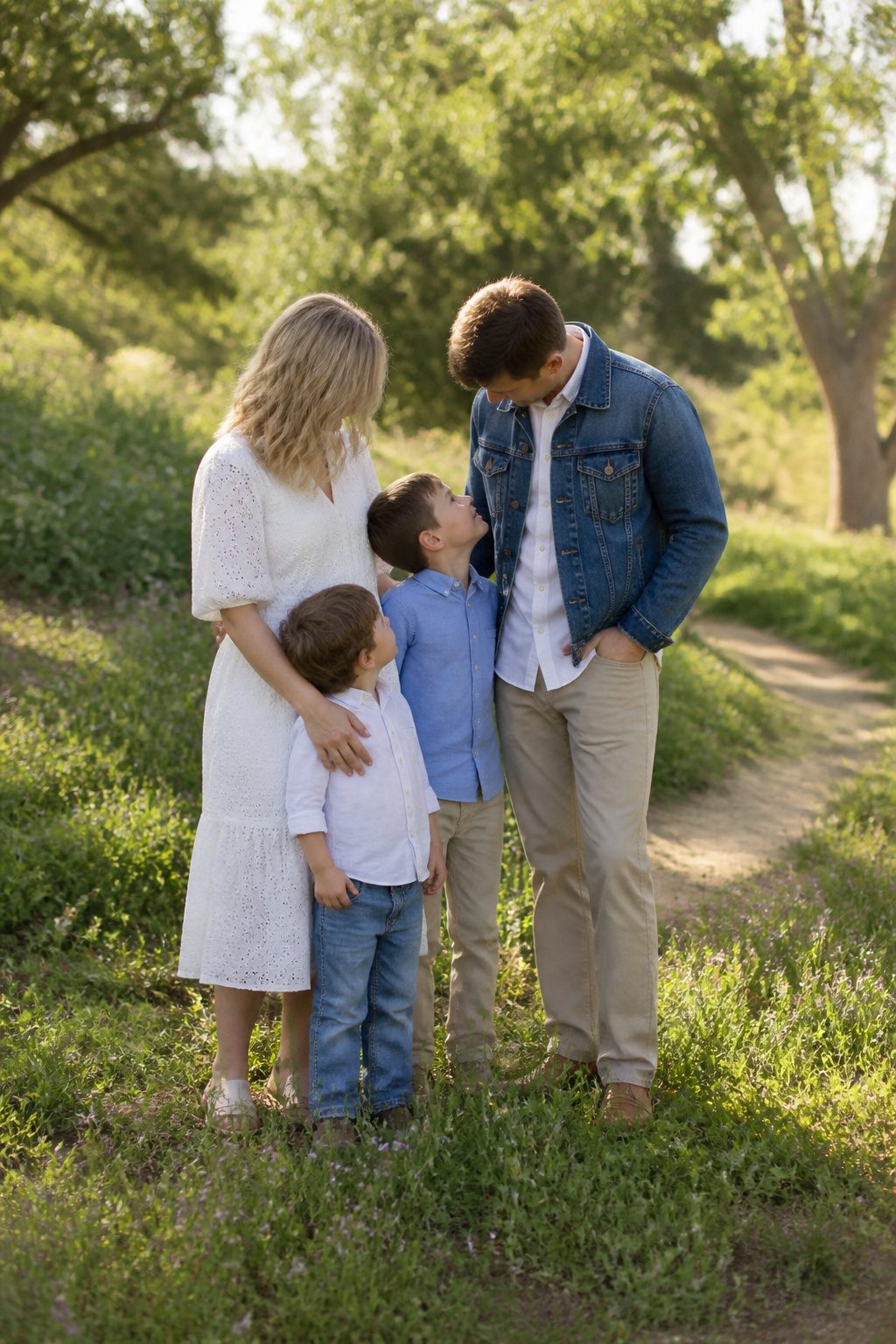
Denim and white only works in photos when you treat it as a color story with strict rules on texture and wash. Put everyone in the same medium-wash jean jacket and plain white cotton tee and you get a uniform, not a family. Vary the denim from light to dark across the group so the blues read as separate layers against the camera. Mom in a white eyelet midi dress with a medium-wash jacket anchors the look; dad in a denim shirt over white, but with khaki pants, not jeans, breaks the symmetry. For kids, skip the cotton tee entirely. White linen overalls, a lace-trimmed dress, or a chambray shirt layered over something softer gives the white pieces actual texture under spring light. The eyelet, the linen, the soft knit you might need for a cool morning, the chambray itself: these catch natural light differently than flat jersey. One plain white cotton tee in the group is enough to ruin the depth you built. Keep footwear in the same quiet register: tan ankle boots, brown leather sandals, white sneakers that have aged to something softer than optic white. The goal is clean, not crisp. Crisp reads corporate; clean reads like Sunday.
5. Floral Patterns
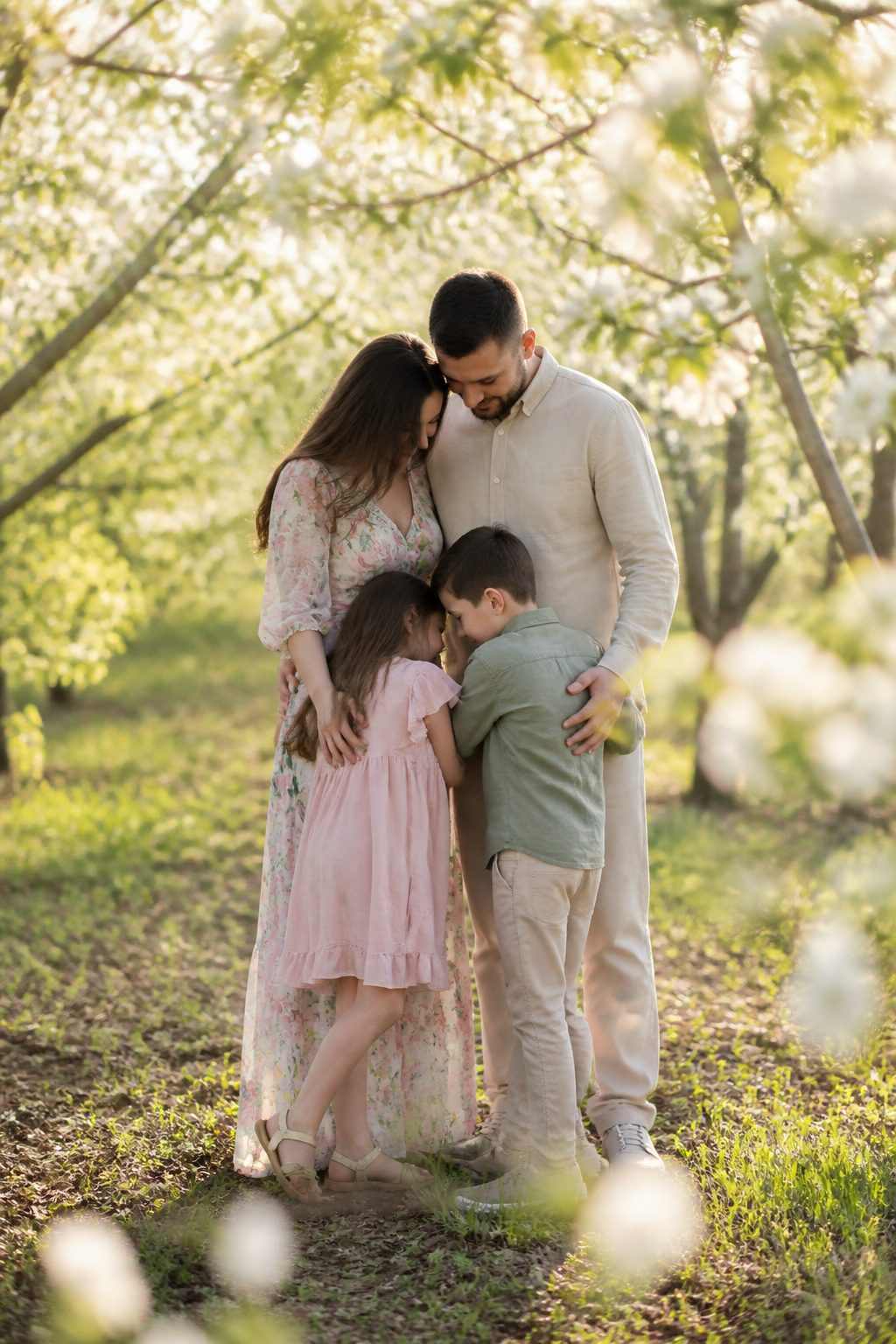
Light floral prints work for spring family pictures because they add texture without demanding attention. Limit bold patterns to one or two family members, then balance them with solids pulled from the print itself. If you put mom in a watercolor floral maxi with pink, lavender, and green blooms on a cream base, dad wears sage and beige, and the kids wear solid dresses or shirts in those same accent hues. The small-scale prints read as neutrals from a distance, letting one bolder floral carry the visual weight.
Scale, color density, and background color are what separate spring florals from summer or fall versions. Spring florals stay small and scattered with lower contrast, think tiny buds on white or cream rather than dense tropical leaves on black. The background matters as much as the bloom: soft white, ivory, or pale oatmeal keeps the mood lifted and seasonal. A darker ground or saturated jewel tones shift the same print toward autumn, even in April.
6. Gingham Patterns
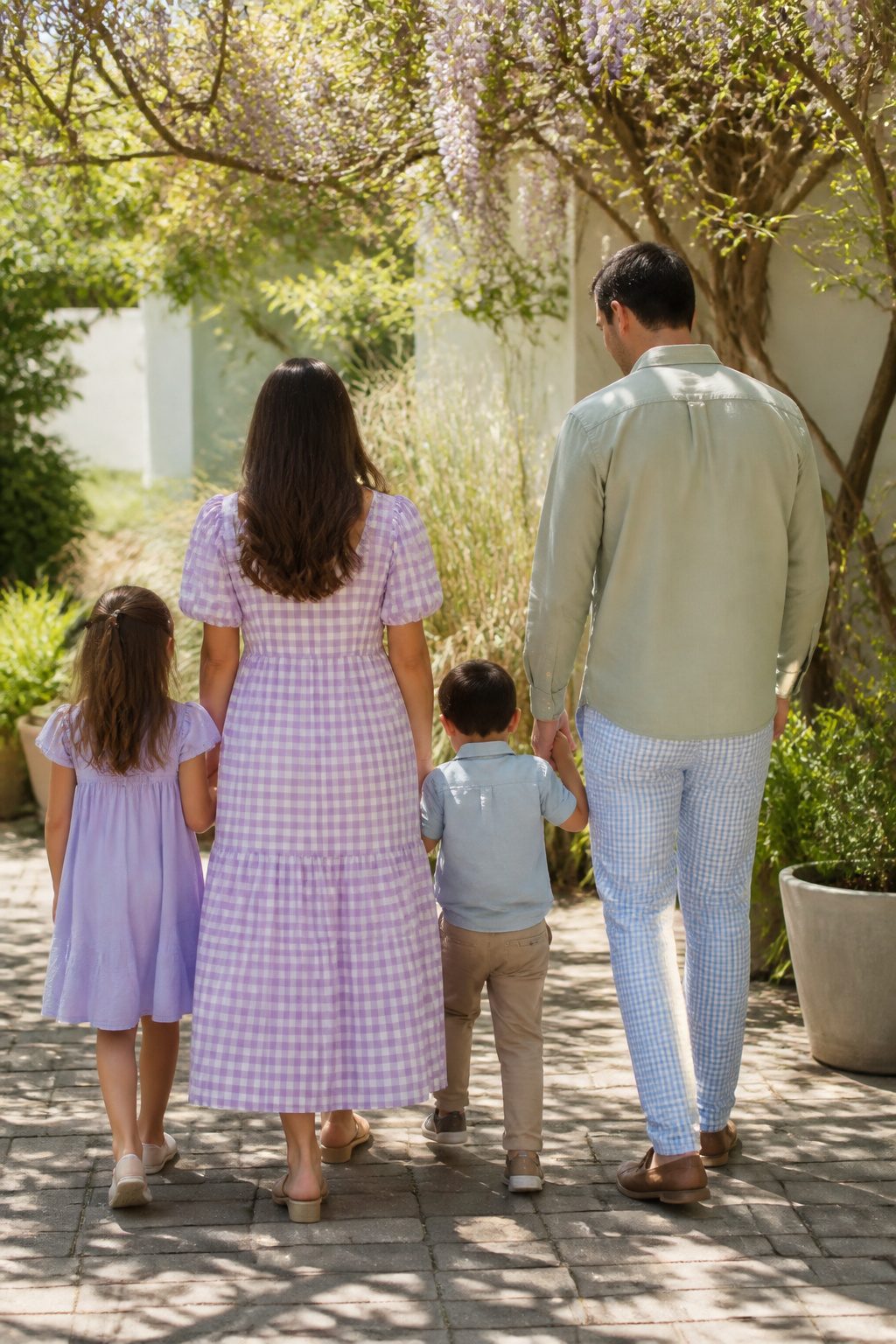
Gingham gives you pattern without the risk of florals that fight each other across the frame. The check reads as texture from a distance, which is exactly what you want when half the family needs to wear it and half needs to sit quietly beside it.
Scale is the detail that makes or breaks it on camera. A very small check can photograph oddly, shimmering or vibrating where you wanted calm. Look for a larger grid, roughly the size of a postage stamp or bigger, especially on adult frames. On kids, the same rule relaxes slightly, but the principle holds: if you have to squint to see the squares, the camera may struggle too.
Color matters as much as size. High-contrast black-and-white gingham grabs the eye first and holds it, which turns one person into the subject and everyone else into background. Soft, faded versions, think lavender and white, dusty blue and cream, or sage and ivory, let the pattern do its job without shouting. These washed-out checks blend with spring backdrops instead of boxing them out.
Put gingham on one, maybe two people, and keep the rest in solids pulled from the same palette. Mom in a gingham midi dress, dad with the check only on a shirt worn open over a solid tee, kids in lavender or white. The pattern stays contained, the family reads as connected, and nobody’s outfit wages war across the photograph.
7. Seasonal Fabrics
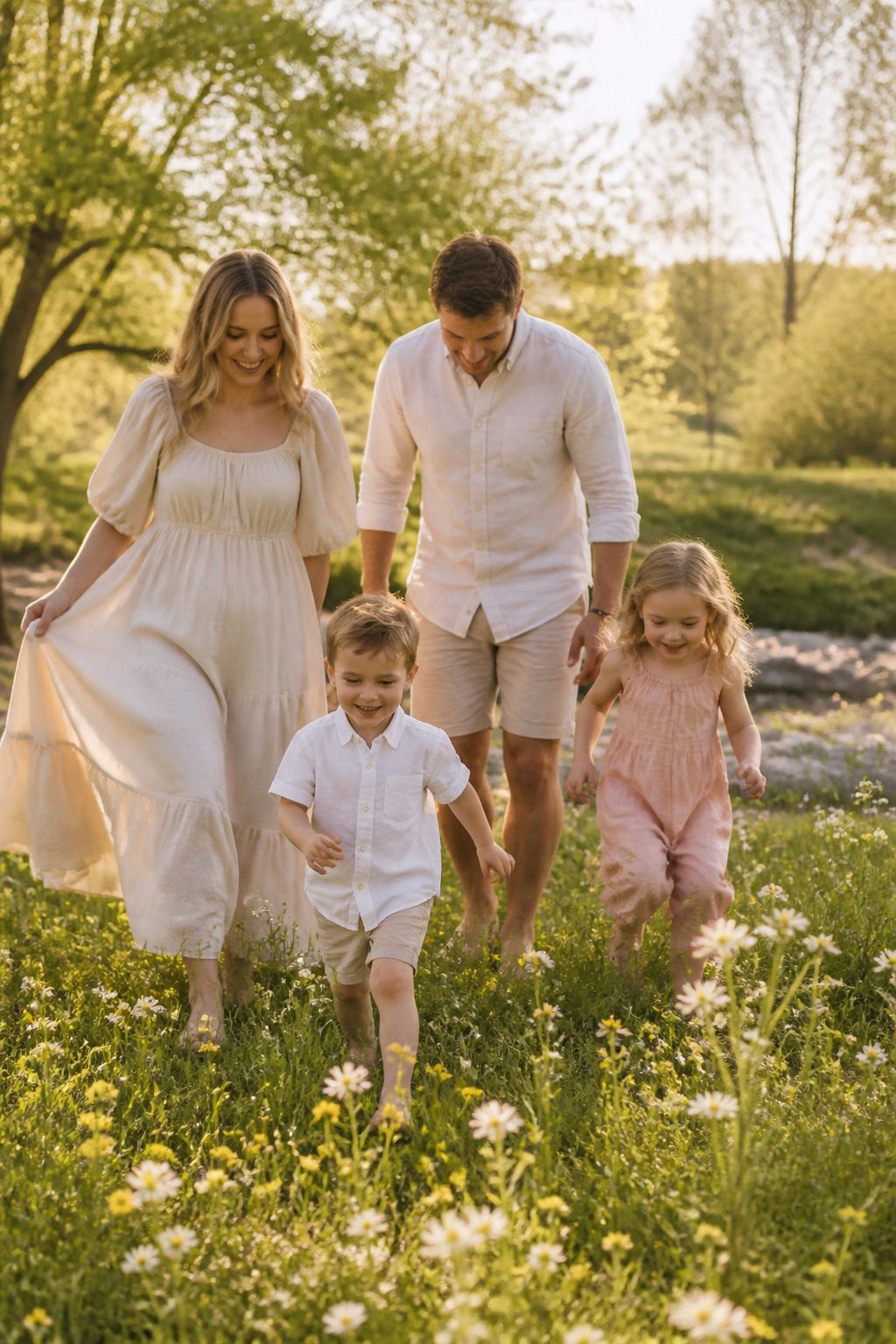
Cotton and linen are the two fabrics that keep spring family pictures from looking stiff. A mid-weight cotton, around five to six ounces per yard, holds enough structure to drape cleanly without collapsing into creases the moment someone sits on the grass. Linen works best at a similar weight, roughly 5.5 to 7 ounces; lighter than that and it wrinkles before you reach the location, heavier and it starts to fight the mild temperatures that make spring shoots comfortable.
What to leave at home: anything with a high synthetic content. Polyester and its cousins catch sunlight at odd angles and throw back a faint shine that reads as cheap in camera. Rayon blends can look promising on the hanger but tend to bunch and cling once body heat hits them. Skip fabrics that crease if you breathe on them, too. A linen-cotton blend, around 55 percent linen to 45 cotton, gives you the texture without the instant rumple of pure linen. For children who will be picked up and set down repeatedly, this blend saves you from the mid-session panic of a shirt that looks slept in.
8. Layering Options
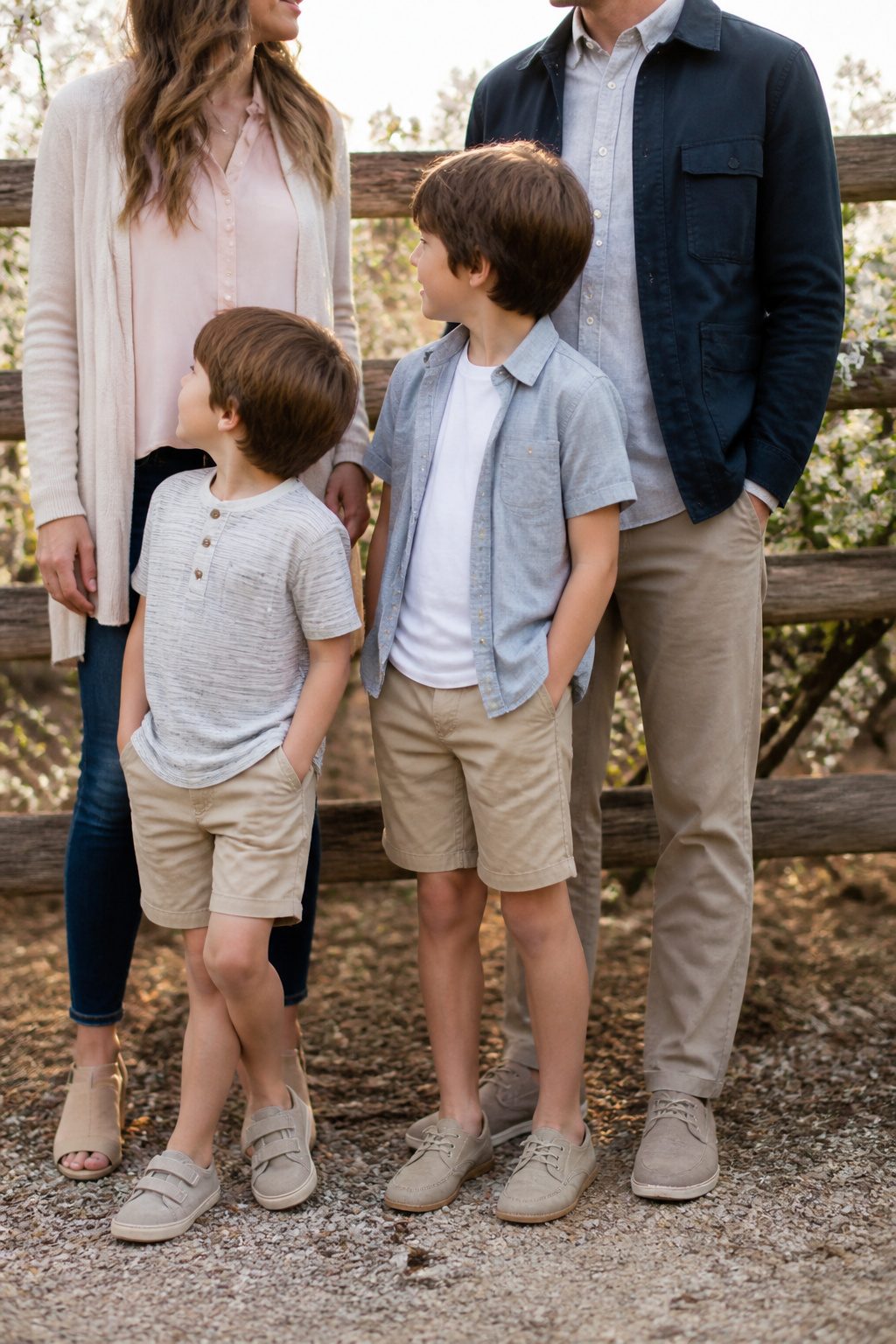
Spring weather will swing sixty degrees one day to pushing eighty the next, so build every outfit around a layer that can leave and come back without wrecking the look. A light cardigan or a denim jacket does this best when the color underneath is chosen to stand alone. Pick a base layer, a tee or a blouse, in a tone that still reads complete against your skin and the rest of the family when the jacket comes off. Sleeve length matters more than people expect: three-quarter sleeves on your base layer sit cleanly under a cardigan without bunching at the elbow, and a slim long sleeve rolls neatly under a denim cuff. For little ones, a sweater draped over the shoulders looks intentional in photos if the temperature dips, not like an afterthought. Skip anything too oversized; the layer should come off without pulling the shirt beneath it out of place. Breathable cotton or linen keeps everyone comfortable when the sun surprises you, and a backup layer stashed nearby handles the cooling that hits fast during sunset sessions.
9. Accessories
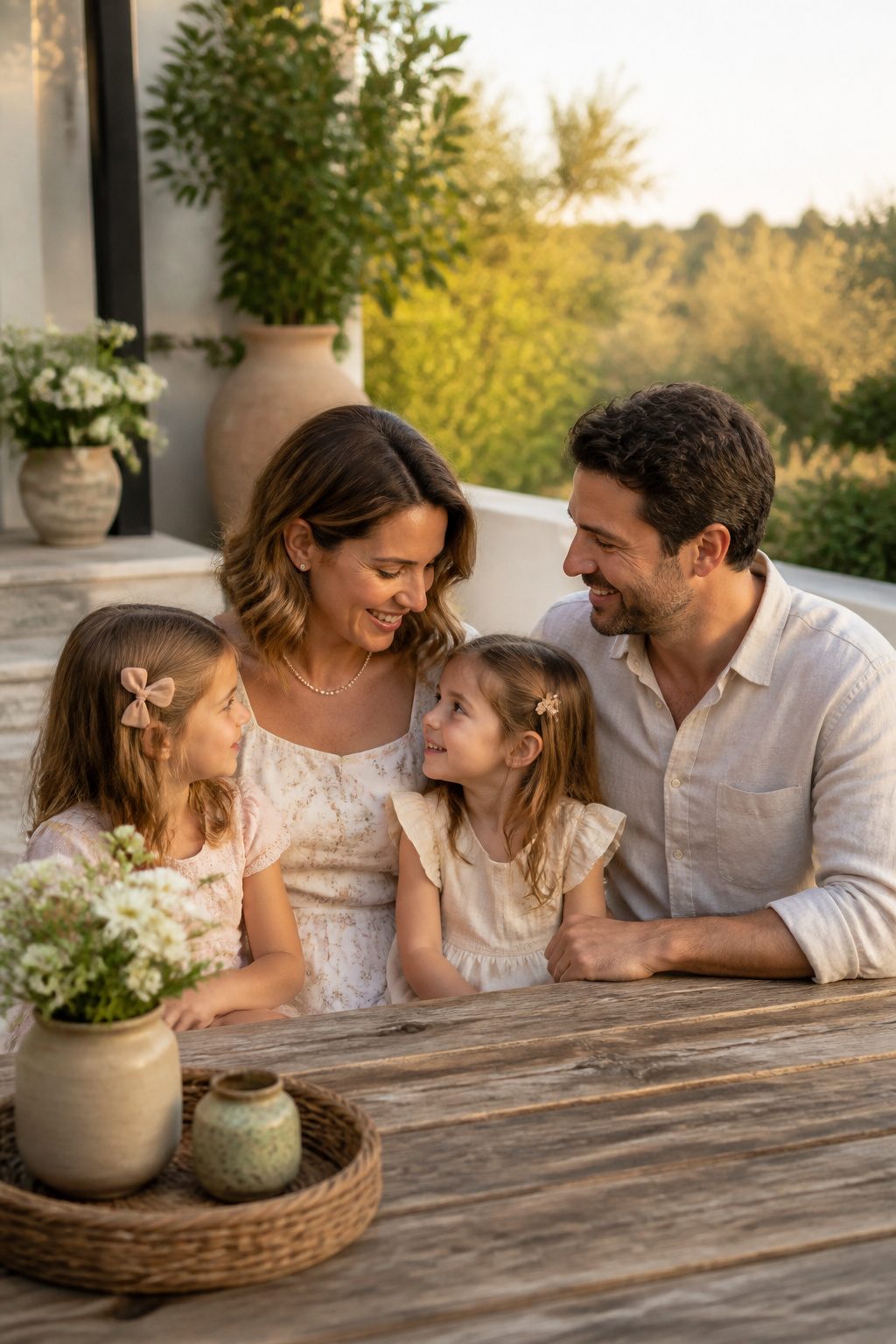
A thin gold chain or small pearl stud does the work of a whole jewelry box in family photos. The rule is light on skin, nothing that throws its own shadow or catches a hard glint from the side. You want someone studying the photo in ten years to notice faces first, then maybe the soft loop of a necklace second.
Watches read as clutter on a wrist that rests on a child’s shoulder. Belts divide the body horizontally, which helps some shapes and cuts others in half; if the outfit already fits, skip it. Hair pieces for kids need the same test: does the bow hold its place without a morning of adjustments, or does it slide and get fussed over between shots? One small clip that stays put beats three perfect ones that don’t.
The photographers who shoot these sessions repeatedly mention manicured nails and pressed clothes as the finishing layer. That is not vanity. It is the difference between a group that looks dressed for the moment and a group that looks dressed for the camera.
Outfit Coordination Rules
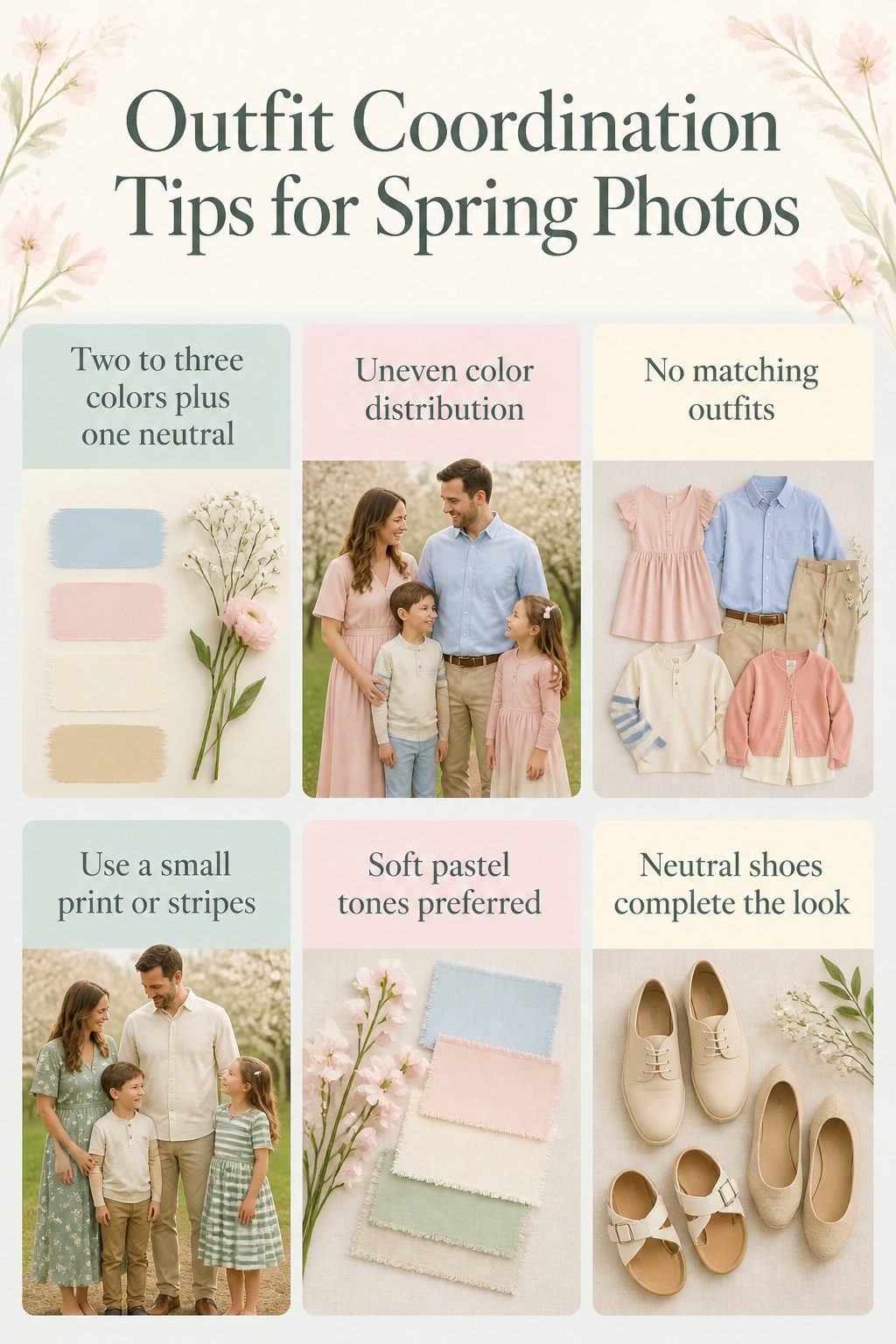
The biggest outfit mistake in spring family photos still comes from the 90s playbook: everyone in matching white shirts and jeans. It reads dated now, and it flattens the people in the frame into cookie-cutter clones. What works instead is coordination through a shared palette with real variation.
Start by picking two to three colors plus one neutral, then distribute them unevenly across the family. If you land on soft blue, blush pink, and cream, the palette does not mean each person wears all three. Mom might wear a blush dress, dad a light blue button-down with khaki pants, one child in a cream top with blue accents, another in pink with cream bottoms. No single color dominates, and no two people mirror each other.
For a four-person family, try mom in sage green with a subtle floral, dad in oatmeal trousers and a cream shirt, one child in light khaki, the other pulling in the same sage through a small stripe or accessory. The neutral shoes, white or beige sandals, ground the group without adding another competing hue. One small print, delicate stripes or soft florals, keeps the eye moving without tipping into chaos. The soft intensity level matters more than the specific pastels you choose.
Dad Outfit Specifics
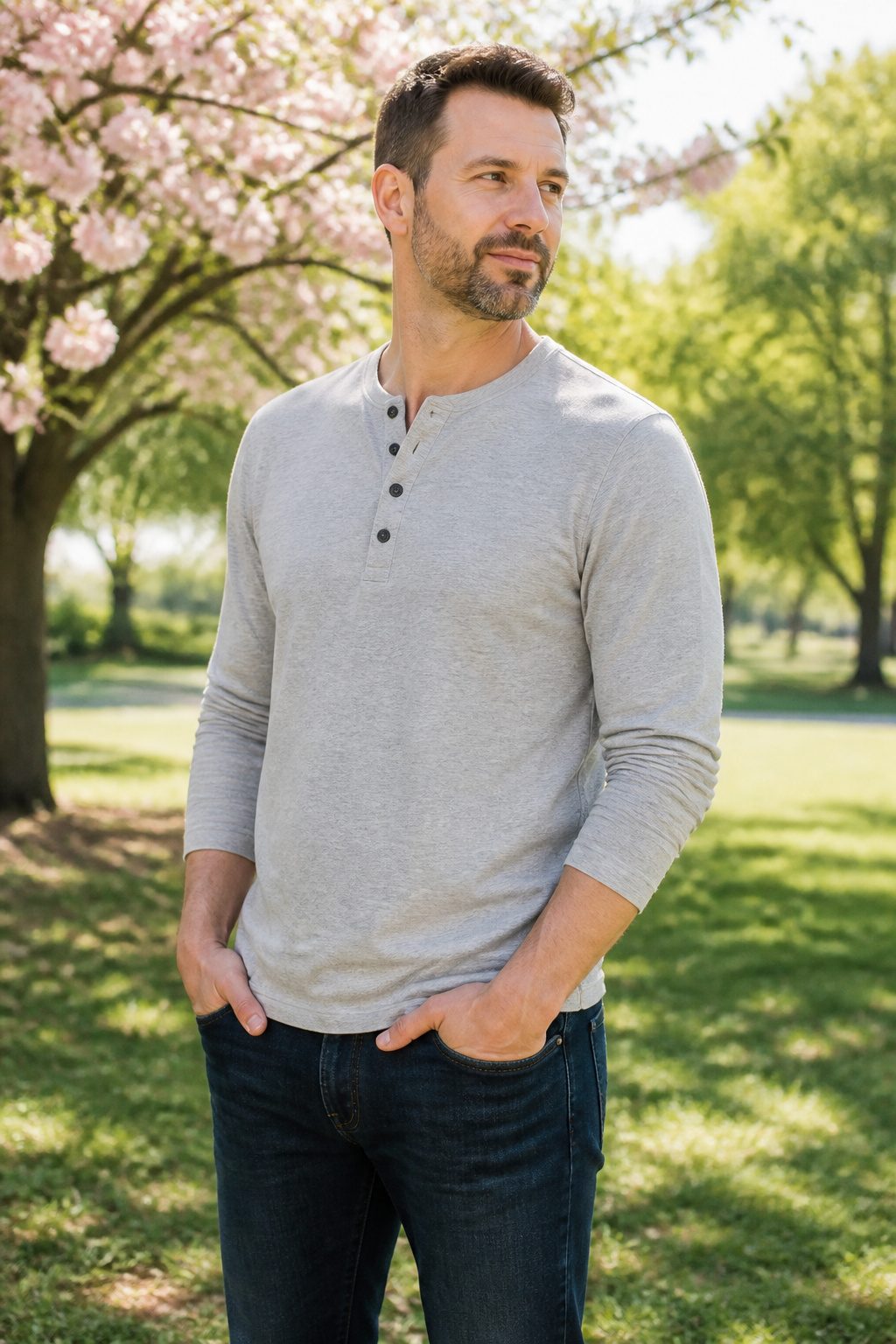
Dad’s outfit is where spring family pictures outfits live or die, and the mistake is usually overthinking it. Comfort comes first, because a photographer will ask him to run, lift a kid onto his shoulders, or sit on grass that will stain. If he is not a button-down person, do not put him in one. A simple henley or soft tee in a neutral or jewel tone, paired with jeans or cords, reads clean on camera without fighting the rest of the family.
Simplicity means two things: cut and color. The cut should be slim enough to look intentional but loose enough to move in. The color should stay in the same family as everyone else without matching exactly. Light blue, gray, beige, or navy all work; a light blue gingham button-down with dark slacks is one polished option, but so is a plain tee with dark jeans if that is what he actually wears.
Where dads go wrong is anchoring too hard. He should complement mom’s outfit, not mirror it, and he should never be the only one in shorts, the only one in black, or the only one dressed like he is heading to a different event. The goal is coordinated, not cookie-cutter.
Kid Outfit Specifics
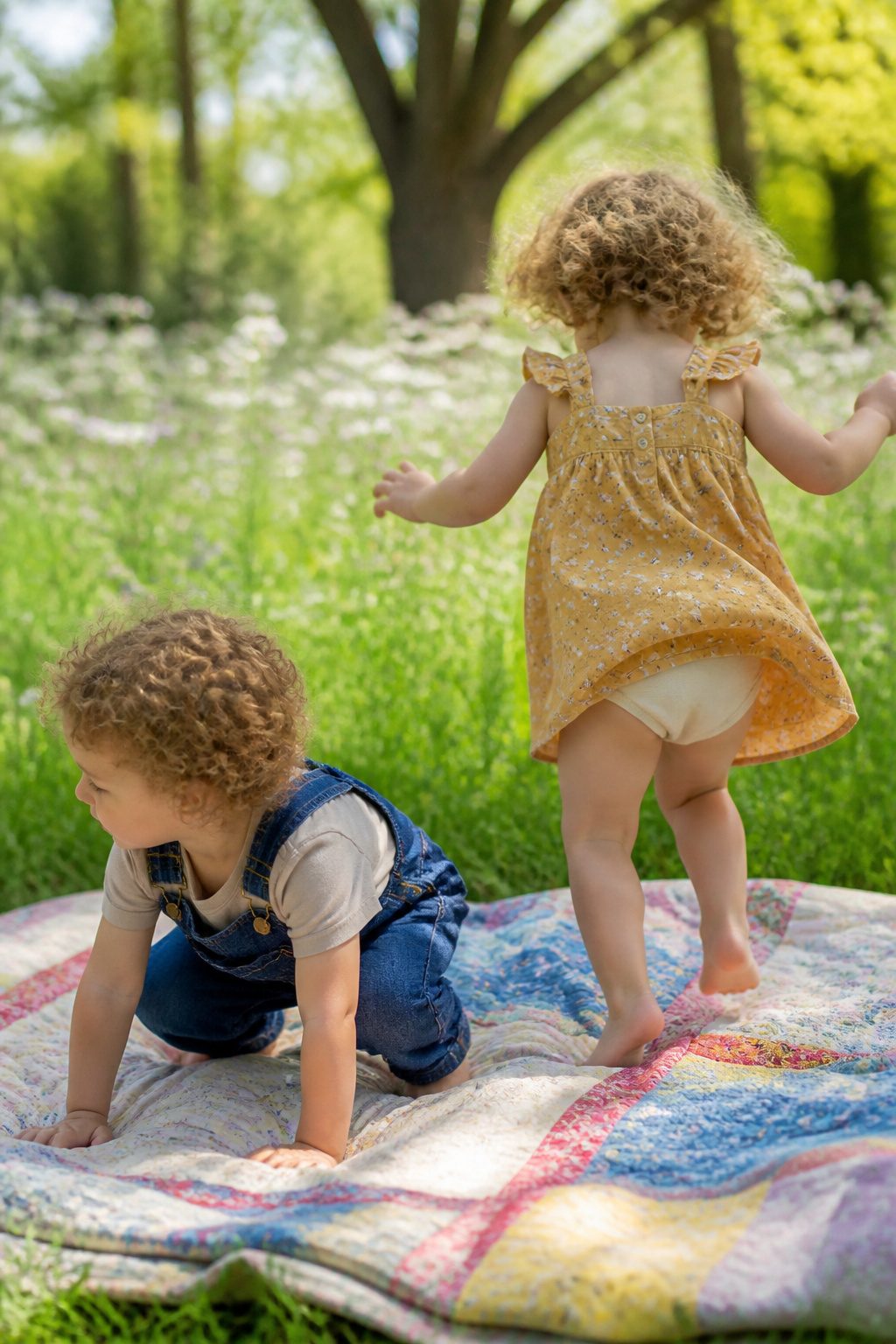
Overalls and rompers work for spring family pictures because they are one-piece outfits that reduce wardrobe malfunctions and cut your prep time. You get a put-together look with one item to coordinate, and the cut lets kids climb, run, and get picked up without restriction. Shorts under sundresses serve the same purpose, keeping a toddler covered during all that movement.
Comfortable children photograph better than styled ones. Skip stiff or itchy fabrics and choose pieces they can move freely in. For shoes, match the location rather than the outfit alone. Flats or low wedges handle grassy parks; beaches call for bare feet or easy-to-remove sandals. Secure shoes matter for active little ones. Teens need involvement, not assignment. Let them into the styling process and guide them toward the family palette rather than handing them a finished look. The buy-in shows in their expressions.
Weather Backup Plans
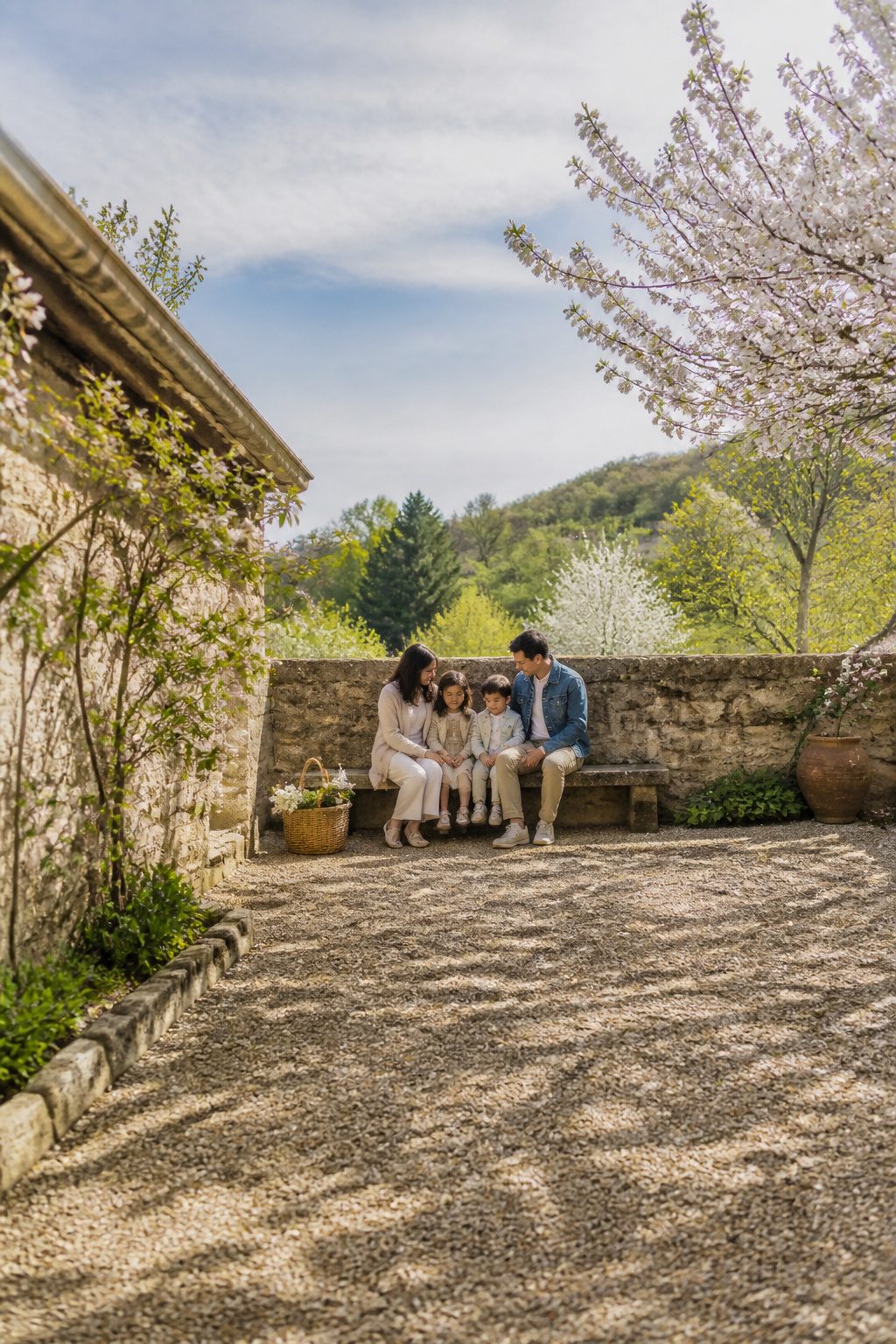
Spring weather flips fast, and your layers need to work in the frame, not just hang on a nearby chair. A lightweight cardigan or denim jacket in a color that already sits in your palette can stay on for half the session without looking like an afterthought. Drape a sweater over shoulders, let a toddler keep their jacket zipped, and the photo still reads intentional.
For kids, pack a backup outfit. Spills happen, and spring ground is often wetter than it looks.
Check the forecast the day before, but know the hard stop. If the temperature drops below the 50s or rain is steady rather than scattered, move indoors or reschedule. A stylish umbrella buys you a few fun shots in light drizzle, but shivering family members show in the face even when the outfit holds up. Breathable cotton or linen layers keep everyone comfortable through temperature swings that can jump from 60 to 80 degrees inside a single afternoon.
Frequently Asked Questions
What should we wear for spring family photos?
Start with light neutrals such as cream, tan, or soft white, then add one or two complementary colors like sage green, dusty blue, or soft blush. This base lets spring backdrops of wildflowers and new grass shine instead of competing with your clothes.
How do I coordinate outfits for family photos?
Pick two to three colors plus one neutral, then distribute them unevenly so no two people mirror each other. Vary tones within the same family so outfits coordinate without matching exactly, and keep bold patterns limited to one or two people.
What patterns work best for spring family photos?
Light florals, delicate gingham, and small-scale prints work best, limited to one or two family members while the rest wear solids pulled from the print. Space patterns throughout the group rather than clustering them, and avoid high-contrast or dense designs that read as chaotic on camera.
What fabrics are best for spring family photos?
Mid-weight cotton around five to six ounces per yard and linen at roughly 5.5 to 7 ounces hold structure without collapsing into creases. A linen-cotton blend, about 55 percent linen to 45 cotton, gives texture without the instant rumple of pure linen; skip synthetics that catch light at odd angles.
Where can I shop for spring family photo outfits?
Old Navy, Target, and Amazon carry budget-friendly options that coordinate across baby to adult sizes. Zara, Gap, Morning Lavender, Jamie Kay, Pink Blush, and Roolee also stock timeless pieces that photograph well for spring sessions.